

ACQUIRE
Know what you’re buying.
Understand earnings, working capital, and the financial implications of the deal.
- Target & earnings analysis
- Acquisition and financing scenarios
- Diligence preparation & coordination
Institutional finance for PE-backed companies
Experienced finance professionals and one connected platform, running your accounting, reporting, and financial operations.
Your Ordovar team prepares, reviews, and delivers the work. You get finished reports, a clear view of performance, and experienced people to discuss what comes next.
June 2026 · Management brief
Reviewed by Ordovar
The operating readout
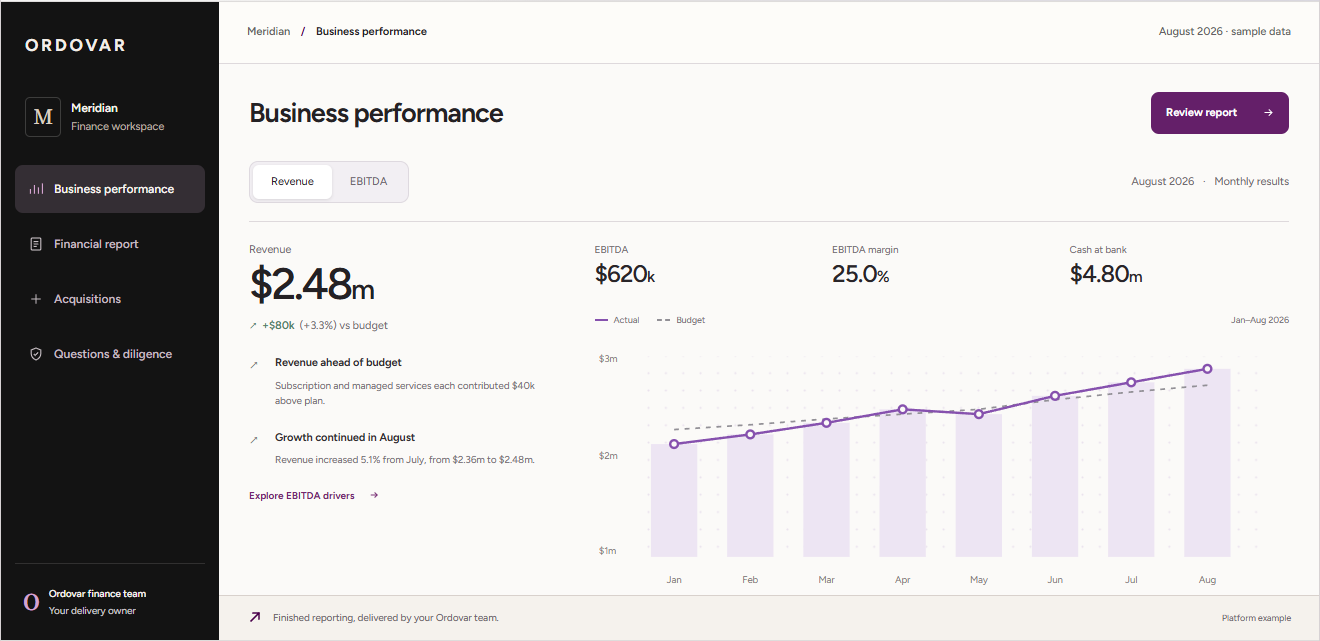
Revenue contribution more than offset higher payroll, lifting adjusted EBITDA 12% above plan. Your June close is complete.
AI prepared the source records and reconciliations. Ordovar resolved accounting judgments, completed the close, and reviewed the reporting. You review the finished outputs.
↗ +$80k (+3.3%) vs budget
Subscription and managed services each contributed $40k above plan.
Revenue increased 5.1% from July, from $2.36m to $2.48m.
Acquisition planning · Sample assumptions
$24.0m net debt ÷ $8.0m annualized EBITDA = 3.0×.
No synergies or integration costs modeled. The example uses a simple net-debt test.
Headroom = 4.0× less modeled leverage. Debt capacity = 4.0× EBITDA less net debt.
Financial diligence · Example request list
| Request | Response status |
|---|---|
| FIN–01Revenue testingRevenue bridge & sample invoices | |
| FIN–02Debt & covenantsDebt schedule & covenant test | |
| FIN–03Working capitalReceivables aging & collections |
Read the finished response or see what your Ordovar team is following up on.
Explore performance, acquisition scenarios, and diligence.
Illustrative views · sample dataBuilt for the demands of ownership
Your Ordovar team runs the finance function through acquisition, growth, and exit.
For CEOs and their investors.
Understand earnings, working capital, and the financial implications of the deal.
Turn another entity into a coherent part of your finance operation.
Build the financial record that helps buyers understand the business you’ve built.
The continuous financial data room
Financial statements, schedules, and supporting records organized as the work happens. Your Ordovar team manages diligence requests through completion.
The people behind your finance function
Our team brings experience across private equity, investment banking, hedge funds, and search funds.
We run the accounting, deliver reviewed reporting, and support board and transaction decisions. Your Ordovar team owns the financial workstream through audit and diligence.
You receive finished reports and a team accountable for delivery.
A complete finance function
Select a service.
See the work behind it.
Exceptions brought forward.
Support retained. Judgment applied.
Four weeks ahead.
1.0× headroom against the sample limit
Illustrative: $24m net debt ÷ $8m covenant EBITDA. Actual calculations follow your credit agreement.
The numbers, the narrative, and the questions to anticipate.
Example Group / June
June revenue finished $280k ahead of plan. Adjusted EBITDA was $120k above plan.
| Week | Inflows | Outflows | Closing |
|---|---|---|---|
| Week 1 | $240k | $205k | $810k |
| Week 2 | $185k | $260k | $735k |
| Week 3 | $270k | $215k | $790k |
| Week 4 | $210k | $195k | $805k |
Cash begins at $775k. Week 2 includes a larger payment run; confirm collection timing beforehand.
Explain the revenue and cost movements.
Review the coming payment cycle.
Connect the financial outlook to priorities.
The numbers, the narrative,
and the questions to anticipate.
Linked: monthly ledger, revenue schedule.
Ordovar review: adjustment checked and documented.
Vendor · amount · supporting record
Account · entity · duplicate checks
The right approver. The full context.
Approved payment run · ledger support
The platform moves the work forward.
Your Ordovar team manages the accounting and exceptions.
Simple 80 / 20 example. Waterfall models follow the agreed ownership terms and distribution tiers.
AI prepares reconciliations, entries, and supporting schedules. Your Ordovar team reviews the accounting and delivers finished financial statements, with the detail behind them in place.
Know what you can fund, where cash gets tight, and what your lenders need. Your Ordovar team maintains the forecast, calculates covenants, and prepares lender reporting.
A clear view of performance for management, the board, and your sponsor. Financials, operating KPIs, and commentary tell one coherent story.
Experienced finance professionals help you turn the numbers into a board conversation: what happened, why it matters, and the decisions ahead.
The platform assembles schedules, evidence, and draft responses. Your Ordovar team manages requests, reviews the work, and follows through on delivery.
Your Ordovar team manages billing, collections, and vendor obligations through connected workflows. Clear controls keep business approvals with the right people.
See how the business is structured and how value flows to its owners. Model investor returns and distributions using your agreed economic terms.
Financial expertise through acquisition, integration, and eventual sale. Bring each add-on into group reporting and build the record for your next transaction.
Rapid data migration, a deliberate review,
and a finance team taking ownership.
Bring your systems, entities, and historical records together.
Check balances, identify cleanup, and establish your reporting.
Your Ordovar team runs the close and agreed recurring work. You receive finished reports.
AI reduces the manual work. Our experts own the delivery. You get an institutional finance function at substantially less than the cost of building it in-house.
A defined scope. A predictable monthly fee. Additional work agreed in advance.
Explore your team and costCompare the full cost: delivery team, platform, implementation, project work, and any roles you retain in-house.
Both. Your Ordovar team runs the agreed accounting and financial operations using our connected platform. We prepare, review, and deliver the work. You receive finished reports, visibility into performance, and experienced people to discuss the numbers with.
No. Your Ordovar team handles the accounting and journal entries. Your view is built around finished reports, business performance, and decisions that need your judgment.
Yes. We can support an existing finance leader or handle a broader finance function. We agree who owns each activity and approval, so your internal team has clear responsibilities and the support it needs.
Our team manages data import, account mapping, historical reconciliation, and reporting setup. We agree the records to bring across, identify any cleanup work, and establish who owns each recurring deliverable. Your systems and the condition of the records determine the transition plan.
It keeps financial statements, supporting schedules, and evidence organized through the regular finance workflow. Audit and transaction-specific requests are handled as they arise, with clear ownership of missing information and follow-up.
Your proposal sets out the recurring deliverables, responsibilities, platform access, and monthly fee. Projects such as acquisitions or historical cleanup are scoped and approved before work starts.
Tell us about your company, your finance team, and the priorities ahead, from improving the close to preparing for an acquisition or exit.